Why choose the Nelu Close carrier?
"Is this truly safe for my baby?" - this question has been with us since day one of working on Nelu Close. A baby carrier is not just another layette item that sits in the closet just in case.
It is something your baby spends hours in - during walks, in the grocery checkout line, on the way to the playground, sometimes on the way to falling asleep. Since they spend so much time in contact with it, we felt we couldn't settle for "it's probably fine." It had to be certain.
Nelu Close is tested in an independent laboratory SGS (heavy metals, formaldehyde, flammability, physical strength), sewn from natural fabrics (100% cotton or 90% cotton / 10% linen), with a wide adjustable seat supporting the "M" position and a weight range of 3.6-16 kg. Full reports are available upon request.
It all started with a question every parent asks themselves
Instead of relying solely on our own claims, we regularly send our carriers to an independent SGS laboratory - one of the world's largest and most recognized testing and certification companies.
We don't do this because someone forces us to. We do this because we want to know exactly what we're holding in our hands before we start recommending it to other parents.
What really touches your baby's skin
A baby's skin is completely different from adult skin. It is thinner, more permeable, and a baby's body - including the liver and kidneys - is still learning how to metabolize various substances. That's why standards for baby products are far stricter than those for adult clothing, and acceptable limits for heavy metals or formaldehyde are set with a wide margin of safety.
Our carriers underwent testing that included lead, cadmium, mercury, arsenic, chromium (VI), antimony, and nickel - not just in the main fabric, but also in the webbing, buckles, logo, and labels. The result? All samples passed the test, and most substances were not detected at all. We also tested for formaldehyde - known for potentially irritating skin and mucous membranes - and here, too, the result was clear. On top of that came flammability tests, where the fabric had to show safe, slow behavior in contact with fire, as well as structural strength tests.
We make the full reports from these tests available to anyone who wants to see them - simply contact us. We believe that if we say "tested," we should be ready to prove it, not just mention it.
Why linen, not just cotton
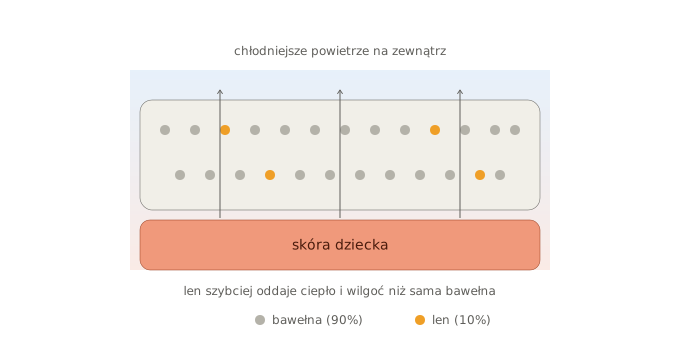
Cotton is a proven choice - soft, pleasant, and good at handling moisture. But when designing one of the Nelu Close versions, we wanted to take it a step further, so we turned to linen. Not out of nostalgia for artisanal fabrics, but because linen has something cotton lacks a bit: a natural ability to quickly release heat and moisture.
Linen fibers have a structure that promotes airflow - helping the fabric "breathe" better than many other materials. In practice, this means that in summer, your baby doesn't get sweaty and overheated in the carrier, while in cooler weather, the same fabric helps retain warmth. Linen is also known as a material less hospitable to bacterial growth on its surface, which matters when fabric stays in close contact with a baby's skin for extended periods. Combining cotton and linen in a 90 to 10 ratio is our way of getting the best of both worlds - the softness of one and the thermoregulation of the other.
The froggy position - a detail that matters for years to come
If you've ever seen a photo of a baby in a carrier, you've probably noticed that characteristic position - knees raised, legs spread out to the sides, a bit like a little frog or a tiny rider. This is no accident, and it's not a matter of style. It is the position that hip development specialists consider one of the healthiest for a baby.
A newborn baby's hip joint is still immature - the socket is shallower than an adult's, and the ligaments are only just forming. When the baby's thighs are supported from knee-crease to knee-crease, the head of the femur can settle deeply and properly into the socket.
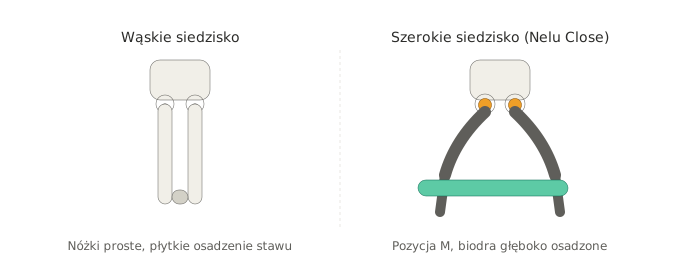
A team of researchers from Boise State University actually looked at this under a microscope - or rather, with an ultrasound machine. They compared the hip positioning of infants carried in wide-seat carriers that support the thighs versus narrow carriers that only support the crotch. The difference was clear, and especially noticeable in infants with mild hip dysplasia - wide-base carriers supported significantly better hip alignment.
Nelu Close has a wide, adjustable seat designed specifically for this position, and it grows alongside your baby - from 3.6 to 16 kilograms, practically from their first weeks of life right up until your little one is sitting confidently on their own.
Closeness isn't an add-on, it's part of the design
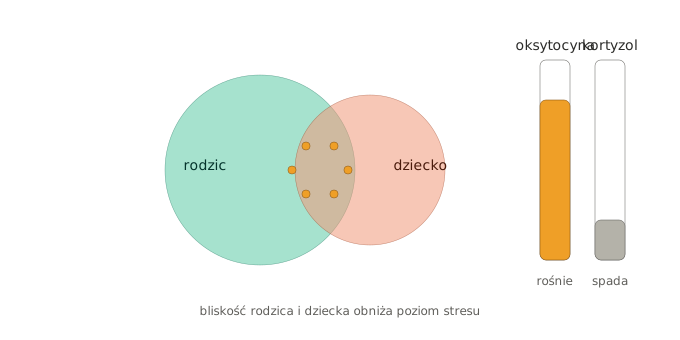
It's easy to forget when designing a product from a purely technical standpoint that a baby carrier exists so a parent and baby can be close. And that closeness goes far beyond the emotional. When a baby is snuggled close to their parent, both bodies release oxytocin - the bonding hormone that helps lower cortisol, the stress hormone. Studies on kangaroo care show that this kind of closeness leads to calmer sleep, less crying, and greater well-being for both baby and parent.
That is why we made sure Nelu Close wasn't just safe on paper, but comfortable enough that you genuinely want to wear it often - not just on special occasions.
Where this transparency comes from
We are a Polish company, and we want parents who choose our carrier to feel completely confident in what they are buying. That is why, instead of relying on vague claims like "tested" or "safe", we prefer to show the evidence behind the words - and we gladly share full test reports with anyone who asks.
Ergonomic baby carrier from 3.6 to 16 kg - a wide adjustable seat, full head support, two carrying positions, and natural fabrics. Discover Nelu Close
Bibliography and sources
- International Hip Dysplasia Institute - Baby Wearing: the M-position and its importance for hip development. hipdysplasia.org
- International Hip Dysplasia Institute - Baby Carriers & Other Equipment. hipdysplasia.org
- Mannen E. et al. (2023), Babywearing Research Confirms Hip Healthy Position in Wide-Base Carriers, Journal of Orthopaedic Research. onlinelibrary.wiley.com
- ScienceDirect (2025), Extended kangaroo mother care - Examining the utility of skin-to-skin contact over the first year of life. sciencedirect.com
- PMC (2024), New policies on skin-to-skin contact warrant an oxytocin-based perspective on perinatal health care. pmc.ncbi.nlm.nih.gov
- ScienceDirect, Multifunctional linen cellulose fabric coating: Combined heat storage and thermoregulation. sciencedirect.com
- SGS-CSTC Standards Technical Services Co., Ltd. Guangzhou Branch - Nelu Close baby carrier test reports, compliance with CEN/TR 16512:2015, EN 71-3:2019+A2:2024, EN 71-2:2011+A1:2014, EN 1103, ISO 14184-1:2011. Full test reports available upon request.
This article is for informational purposes only and does not replace consultation with a pediatrician or pediatric orthopedic specialist in individual cases.